








Megatrend: Artificial Intelligence in banking
Artificial intelligence is the megatrend in banking. Generative AI (generative artificial intelligence, GenAI) in particular is accelerating both the transformation of organisations and the global working world - and the changes will be profound.
The AI potential is particularly high for financial institutions with their constantly growing volumes of data. Banks have a wealth of versatile applications at their disposal, such as fraud detection in payment transactions, automated document processing and in-depth compliance checks. AI can also optimise calculations, making pricing more accurate, credit decisions more precise and reducing the risk of default.
You can rely on our experts' many years of industry knowledge in these future topics, combined with sound expertise in mathematical concepts, algorithms and machine learning.
Whitepaper 2026
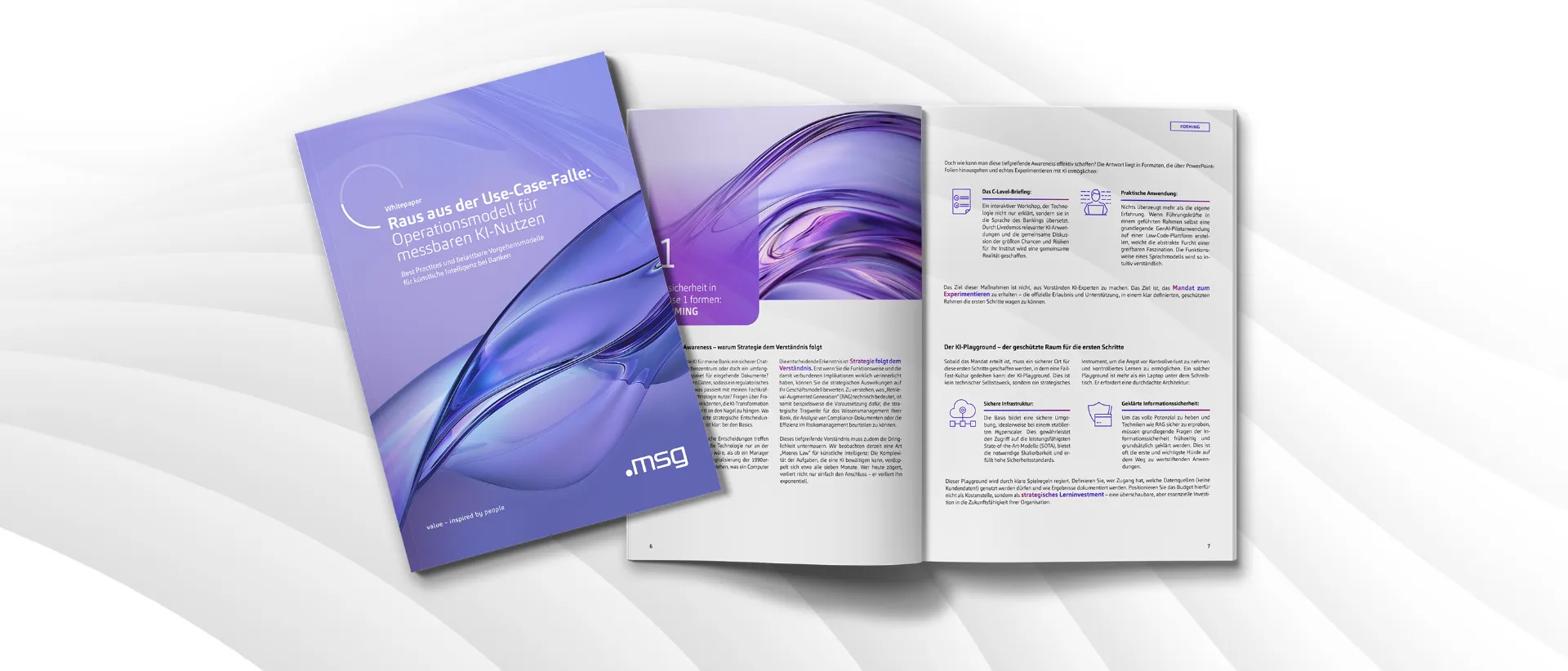
Scalable AI benefits rather than one-off projects: Find out how your institution can approach AI transformation in a structured, efficient and strategic manner.
Do you need to save time and budget?
Künstliche Intelligenz kann Ihnen dabei helfen. Lassen Sie sich von unseren KI-Experten zeigen, wie msg for banking Ihr verlässlicher Partner für die Zukunft des Bankings wird. Ergreifen Sie die Gelegenheit und vereinbaren Sie jetzt Ihren 30-minütigen Beratungstermin - natürlich kostenlos und unverbindlich!
Our services for your AI transformation
We support banks in their transformation to an AI-first bank. Our range of services is based on three main pillars that cover all the necessary steps of the transformation.
AI Strategy

Consultancy and conception
AI strategy goes beyond identifying interesting use cases. We advise you on the development and implementation of a comprehensive AI strategy, taking into account bank-specific regulations, so that you can make well-founded decisions on business and pricing models as well as technological platforms.
AI Factory

From the idea to implementation
We support you in advancing the development of prototypes and productive AI services in your organisation, always with the aim of imparting expertise and creating sustainable solutions. Alternatively, we offer our plug-and-play AIs, which cover all common AI use cases out of the box.
AI Academy

Informed decisions through knowledge
Knowledge is power. With the aim of sharpening your understanding of AI and building up knowledge, we make the technology transparent for you. This enables you to make informed decisions about artificial intelligence applications with confidence.
Efficiency and security through AI in banking
Artificial intelligence and generative AI (GenAI) in particular are revolutionising the banking industry and already offer financial service providers many opportunities, for example to
- strengthen customer contact,
- prevent fraud and money laundering and
- speed up time-consuming tasks such as appraisal evaluation, software development and regulatory and compliance checks.
Other use cases include the assessment and processing of loan applications, the structuring of large databases and the automation and standardisation of repetitive processes.
To remain future-proof and technologically competitive, banks need to make AI an integral part of their IT strategy. We are already working with leading banks to identify and establish AI use cases. Our focus is on innovation and long-term added value to drive the AI revolution.

GenAI
How German companies use them
Download the survey for free!
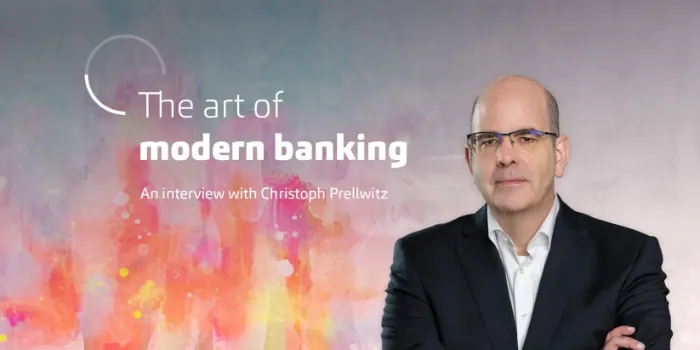

Our AI experts
Our specialised AI experts have the answers to your questions.

heads the Artificial Intelligence division at msg for banking and advises clients on process digitization and artificial intelligence in the financial sector.

Prof. Dr. Dirk Schieborn
Head of Artificial Intelligence and Data Analytics Hub
is an AI expert at msg for banking and holds a professorship in data science and mathematics at the ESB Business School at Reutlingen University.

is responsible for the design and development of an AI product portfolio at msg for banking, manages AI and process management projects, and advises customers on AI-supported digitization of their processes.