








Banks as drivers for a sustainable future
Banks are drivers in the field of sustainability. They are in a key position to master the challenges of transforming society, especially the economy, towards greater sustainability. But just talking about sustainability strategies is not enough. Now is the time to act!
- Customers and stakeholders expect sustainable products and a high level of commitment in the ESG environment (environment, social, governance).
- Following the first climate stress tests, the ECB is calling on banks to focus more strongly on climate risks.
- The 7th MaRisk amendment gives broad scope to the consideration of ESG risks.
Sustainable banking
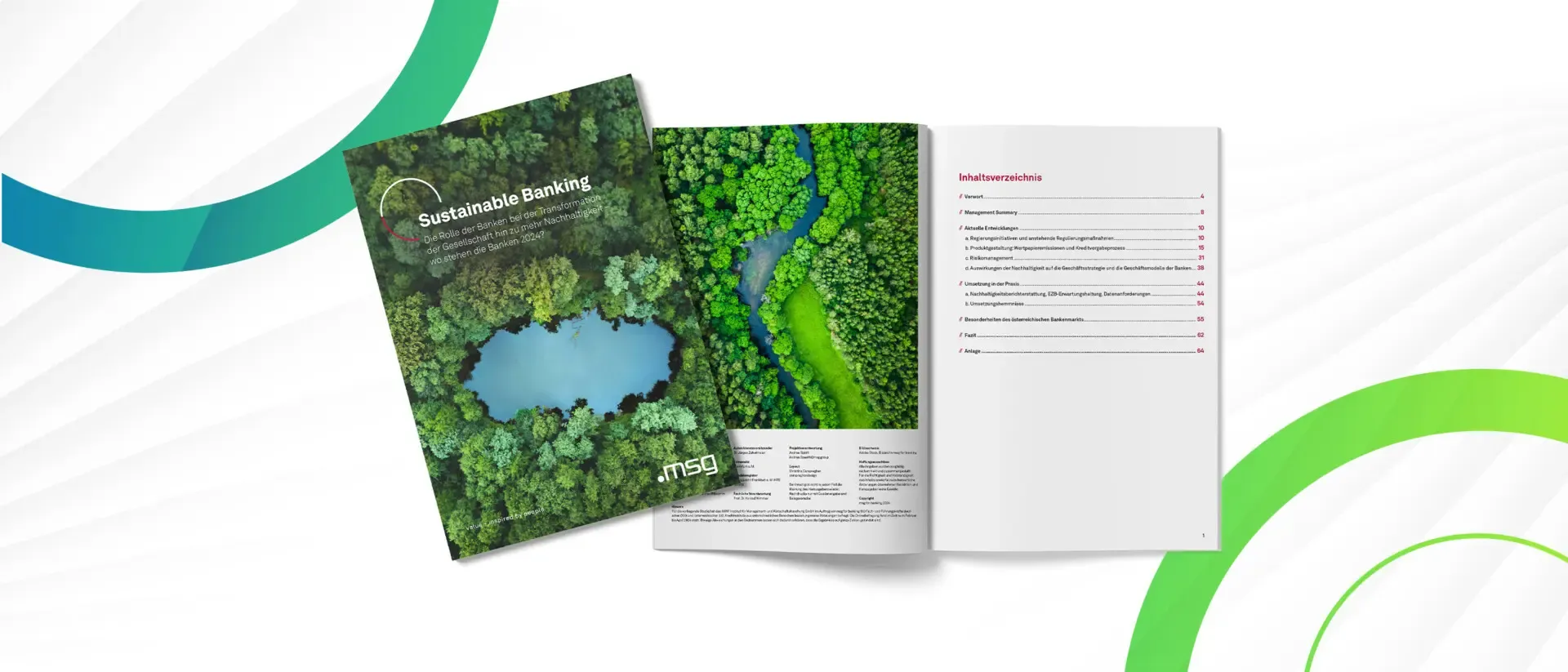
The role of banks in the transformation of society towards greater sustainability
Hurdles in the implementation of sustainability requirements
The regulatory requirements and social expectations of banks to play a key role in the transformation of the economy towards greater sustainability are of great importance at a time of profound change.
At the same time, changes to our environment and climate are leading to new social and economic challenges. Technological advances, social upheavals and regulatory changes not only create risks in banking, but also open up opportunities for a strategic reorientation.
ESG regulation between relief and status quo: How can your institution remain capable of acting?
Our ESG guide, ‘ESG requirements 2025 in transition – how credit institutions can remain capable of acting despite uncertainty,’ addresses important questions and offers step-by-step solutions for data and process integration.
Download it now for free at Banking.Vision.

Lena Gotzler - Head of Department Sparkassen-Finanzgruppe
"Banks that develop and implement a viable sustainability strategy now will give themselves a head start in the transformation process."
Our services and topics in non-financial risk & sustainable finance
- The ecological and social challenges associated with climate change can only be tackled and solved holistically.
- A sustainable financial system implements the activities of financial players for climate and environmental protection, social participation and sustainable corporate governance
- ESG strategy and governance consulting
- MaRisk gap analysis with a focus on ESG risks
- ESG risk inventory and climate risk stress testing
- E2E-ESG data management
- "Green" product design, such as green bonds
- Support with sustainability reporting
- Conception and monitoring of the ESG risk inventory
- MaRisk gap analysis with a focus on ESG risks
- MaRisk implementation project focussing on ESG risks (strategy, credit, risk management, outsourcing)
- Implementation of climate stress tests
- EU taxonomy workshops
- Development of "green" product ideas

Sebastian Bader - Partner Business Consulting Non-Financial Risk & Sustainable Finance
"ESG is much more than just regulation, it is a big part of strategy development for banks. Now is the time to integrate ESG into decision-making"




Together for a sustainable financial world
Challenging times require innovative answers. With our range of services comprising practice-orientated consulting and innovative IT solutions, we support the banking sector in finding constructive solutions to the challenges of sustainability.
software solution

Climate stress testing SaaS
We offer banks a ready-made solution that enables them to fulfil regulatory requirements and gain important impetus for their future orientation.
Sustainability meets cloud solution: Our cloud-based tool msg.CST offers the flexibility to integrate emerging data (sources) while keeping pace with the evolution of climate stress testing.
Ecosystems

End-to-end ESG data management
Only when sustainability and digitalisation are brought together can they unfold their full potential. With this in mind, we offer our customers an entire ecosystem centred around ESG data.
Sustainable advice

ESG risks and business models
Dealing with ESG risks, green investments, social responsibility and changes in governance structures influence banks' business models. With our comprehensive advice, we support banks in the transformation of their business model towards greater sustainability.
Focus on the individual: we advise on an equal footing
We attach great importance to partner-based advice. We listen and take our customers and their issues seriously. This enables us to support them with sustainable solutions that have a positive long-term impact on companies, the environment and society. Get to know our motivated and committed experts.
Sustainable banking - good to know
From the EU action plan for more sustainable growth to sustainable financial investments (green bonds, etc.).) to the expansion of non-financial reporting obligations on environmental, employee and social issues (CSR Directive) - politicians and legislators are sending clear signals about what they expect from companies in order to promote sustainable behaviour in society and the economy. The financial sector is expected to play a key role in the sustainable transformation to achieve the sustainability goals.
The action plan for financing sustainable growth published by the EU Commission in 2018 aims to achieve the following goals:
- Redirect capital flows to sustainable investments,
- manage financial risks arising from climate change and social problems, and
- Promote transparency and long-termism in financial and economic activity.
The action plan contains four adaptation efforts:
- Creation of a standardised EU classification system (EU taxonomy) to distinguish sustainable from non-sustainable economic activities.
- Specification of investor obligations with regard to disclosure and reporting.
- Proposal of two new categories for benchmarks.
- Integration of sustainability aspects into financial advice.
The EU Commission has issued its Sustainable Finance Action Plan in the form of binding rules.
- Alongside the EU Taxonomy Regulation (EU Tax-VO) and the Disclosure Regulation (SFRD), the Corporate Sustainability Reporting Directive (CSRD) is one of the three pillars of the EU's "Sustainable Finance Strategy".
- The CSRD is intended to reform non-financial reporting and replaces the Non-Financial Reporting Directive (NFRD) for this purpose.
- The aim is to equalise non-financial reporting with financial reporting.
- On the one hand, the circle of users is being considerably expanded, while on the other hand the technical depth of the reports is also increasing.
- With the help of the double materiality analysis and the new reporting standards "European Sustainability Reporting Standards" (ESRS), these are now much more quantitatively orientated, whereby both the risk and the impact are to be depicted.
- Due to its integration into the management report, non-financial reporting now falls under accounting law and is therefore subject to external auditing.
- The EU Taxonomy is a scientifically based classification system that determines which economic activities and financial flows are considered environmentally sustainable.
- This provides a standardised definition of sustainability and increases transparency.
- At the level of the financial institutions, the analysed economic activities of the business partners flow together in the "meta-KPI", the "Green Asset Ratio".
- The regulatory framework is being successively expanded, including through the adoption of extended delegated regulations.
- In 2023, for example, four additional non-climate-related environmental targets were established in addition to the climate protection and adaptation to climate change targets.
The European regulation focuses on disclosure on sustainability.
Disclosures Regulation (SFDR)
Since 10 March 2021, financial market participants and financial advisors have been obliged to disclose more data on sustainability. This is regulated by the Sustainable Finance Disclosure Regulation (SFDR), which was adopted on 27 November 2019. In connection with the SFDR, the Joint Regulatory Technical Standards on ESG disclosure standards for financial market participants of the three European Supervisory Authorities (ESAs) should be mentioned, which represent a concretisation of the disclosure obligations under the SFDR.
EBA Guidelines on ESG disclosure under Pillar 3
On 1 March 2021, the EBA published its Guidelines on the disclosure of environmental, social and governance risks (ESG risks) in accordance with Art. 449a in conjunction with 434a of the Capital Requirements Regulation (CRR II) for the purposes of Pillar 3 (transparency for investors and competitors). Disclosure under Pillar 3 is intended to make transparent the extent to which a bank itself is exposed to sustainability risks and how it deals with these risks. The requirements are to be applied from 28 June 2022, while ESG-related disclosure is then to be made every six months.
The European and national supervisory authorities are dedicated in detail to dealing with sustainability risks.
BaFin factsheet on dealing with sustainability risks (final version January 2020)
As a supplement to the Minimum Requirements for Risk Management (MaRisk), the information sheet is intended to provide guidance to the companies supervised by BaFin, how they should deal with sustainability risks. It uses examples to describe the basic approach of the supervisory authority. Sustainability risks do not represent a new type of risk, but have an impact on traditional risk types as well as income and risk concentrations.
ECB Guide on climate-related and environmental risks (final version November 2020)
The European Central Bank (ECB) developed a Guide on climate-related and environmental risks to enable significant institutions to adequately consider these risks in their risk management systems. This guide provides guidance for significant institutions on how to integrate climate-related and environmental risks into their governance and risk management structures and take them into account when defining their business strategy. Institutions should also disclose these risks transparently to the markets.
EBA Guidelines on loan origination and monitoring (EBA/GL/2020/06, in force since 30 June 2021)
. June 2021)
The final report states, that institutions should incorporate risks associated with ESG factors in particular into their strategies for credit risk appetite and credit risk management as well as in their policies and procedures for credit risk. They should also set qualitative and quantitative targets to promote environmentally sustainable lending. The borrower's risks associated with ESG factors should be taken into account in the lending decision.
EBA Report on management and supervision of ESG risks for credit institutions and investment firms (version June 2021)
The EBA Report on management and supervision of ESG risks for credit institutions and investment firms calls on banks to draw up plans for dealing with climate risks over a strategic time horizon of 10 years. ESG risks must be integrated into the business strategy and risk management. Credit institutions should demonstrate how ESG risks can be managed and how resilient they are in different scenarios. The EBA report proposes the Portfolio Alignment Method, the Risk Framework Method with climate stress tests and the Exposure Method as methods for measuring ESG risks.

Have we piqued your interest?
We are experts in the banking sector and know the challenges that banks have to overcome in the context of sustainability. Our range of services includes practicable solutions that ensure your economic success on the one hand and contribute to a positive change in our (surrounding) world on the other. Let's work together to achieve your sustainability goals and create a future worth living.
Your contact

as a member of the Executive Board, he is responsible for sales, marketing and operations, as well as for the business areas of artificial intelligence, payments, and management & business consulting.

at msg for banking, he advises financial institutions on sustainable banking, bank and risk management, including regulatory requirements.