







Low-code/no-code solutions as enablers of digital transformation
The high dynamics of our world, which is characterized by VUCA—volatility, uncertainty, complexity, and ambiguity—requires flexible and efficient work in software development, but also the sustainable, resource-saving, and cost-optimized use of modern technologies.
The low-code/no-code approach and the associated low-threshold application possibilities make it possible: software can be created faster, more cost-effectively, and by a significantly larger group of people.
Low Code
Low code is a method for developing applications easily, but it still requires basic programming knowledge or certain technical skills, such as the ability to write simple scripts or master specific commands.
No Code
No Code is a method for developing applications without writing your own program code. It therefore requires no knowledge of software development and is ideal for creating multiple simple workflows in a short period of time.
Current situation
Digitalization requires companies to implement innovations quickly and cost-effectively. This is the only way they can maintain their competitive edge in the market.
However, while the demand for digital products is growing, the shortage of IT specialists is increasing both in Germany and worldwide and is becoming one of the biggest obstacles to digital transformation.
Added to this are ever shorter development cycles and faster time-to-market. The pressure on IT departments is growing.
In this situation, no-code/low-code offers a promising approach that also offers interesting advantages for the banking industry.
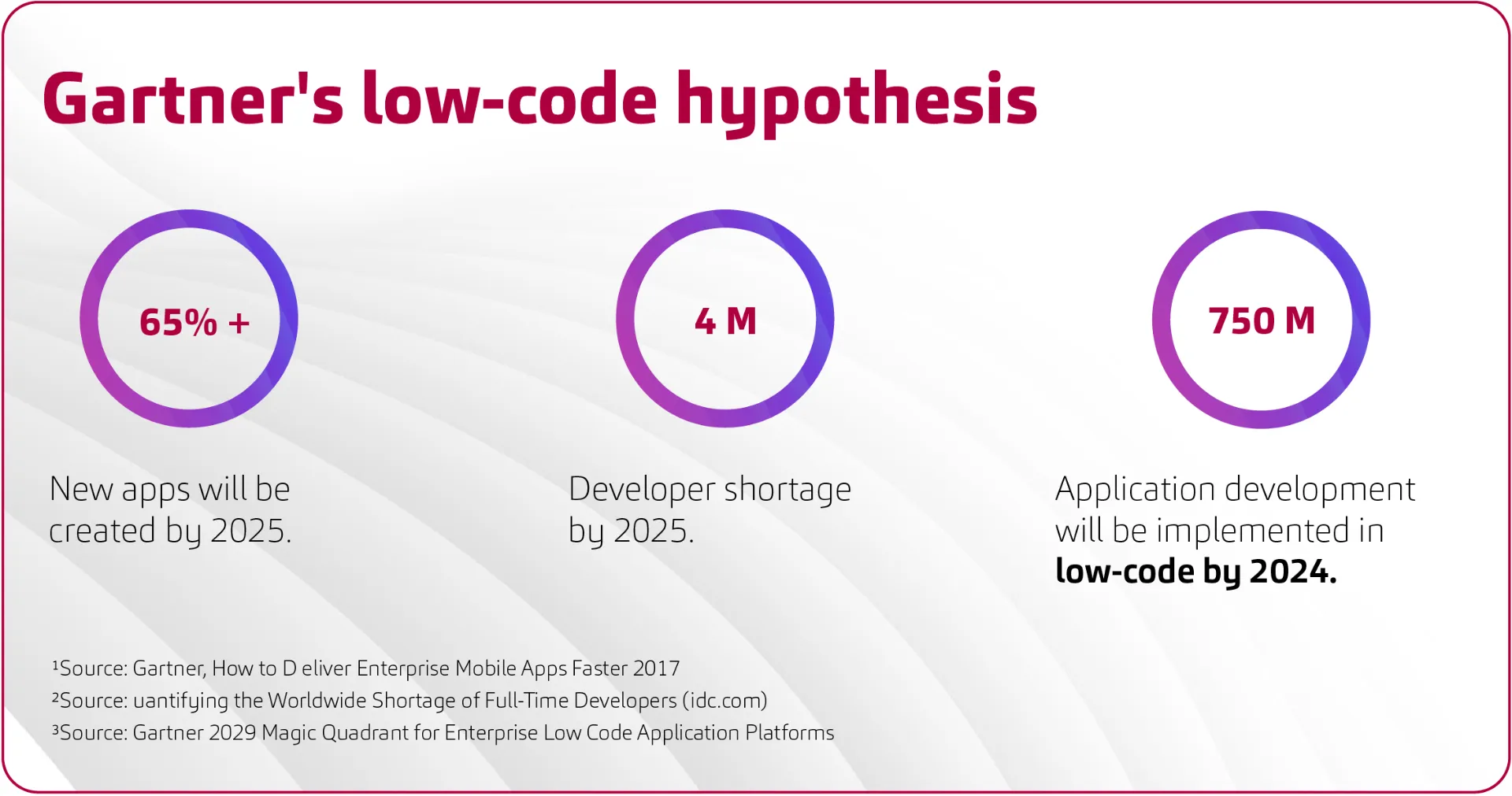
The benefits of low-code/no-code
-
Alleviates IT staff shortages—especially in times of a global shortage of developers.
-
Enables a sustainable and resource-efficient infrastructure and way of working.
- Leads to greater agility, as business units can adapt applications themselves and respond flexibly to market developments.
- Relieves the burden on professional developers and enables modern, flexible, and efficient work.
- Reduces time to market and errors through automation, enabling earlier value creation.
- Optimizes costs for operating and making available applications that are used on a daily basis.
To ensure that the low-code/no-code approach is successful in your institution, it is crucial to select the right platform. In addition, you must define in advance what goal you want to achieve and what criteria the platform must meet to do so.
The following factors must also be taken into account:
- Applications created with low-code/no-code platforms offer only limited customization options and are therefore not suitable, or only suitable to a limited extent, for highly specialized or very complex applications.
- Seamless integration into existing systems can also be a challenge and involve additional effort.
- In order to get employees excited about this technology, new skills must be developed within the team and knowledge gaps must be closed.
With our combination of many years of industry expertise and software competence, our team of experts provides you with comprehensive support in selecting the low-code/no-code solution that is best suited to your institution and your needs.
Our expertise – your advantage
-
We involve our customers and everyone involved in the low-code/no-code project from the very beginning and actively engage them.
-
When selecting infrastructure components, we always keep an eye on costs.
-
Together with you, we will develop a modern, needs-based target vision for you.
- We have a good, sustainable, and flexible solution concept.
-
We take a holistic approach to implementation.
-
We take a structured approach and bring together the right people, partners, and tools.
Our service modules for a successful and future-oriented solution
- Determination of expected functional and usage behavior
- Derivation of technical requirements from expected functional and usage behavior
- Suitability and health check of existing infrastructure
- Joint design of a needs-based target vision, transfer of identified workflows
- Upgrade existing systems to future-oriented web-based software
Cost calculation
- based on the infrastructure target,
- including market services and
- the entire implementation.
- Support in contract drafting, taking into account MaRisk, BAIT, and classification according to significant outsourcing or other external procurement
- Re-design of existing processes
- Introduction of new tools and systems for process modeling and optimization (BPMN 2.0) and thus product, manufacturer, and service provider selection.
- Integration and use of new low-code/no-code components.
- Early involvement of customers
- Joint implementation and definition of responsibilities
- User training, clear presentation of opportunities, risks, and challenges
- Onsite engineering – implementation at the customer's premises with subsequent service support
- Service models for maintenance and further development

Contact

heads the Customer Solutions department at msg for banking in the IT Consulting Cooperative Financial Group division.

advises cooperative financial institutions at msg for banking.

supports customers from the banking industry in the Sales division at msg for banking.